
About Me
I am currently a researcher at the University of Tennessee Health Science Center. I develop reliable, robust, and data-efficient AI for applications in science and healthcare. I earned my Ph.D. in computer engineering from Arizona State University, my M.S. in electrical engineering from Texas A&M University, and my B.S. in electronic information science and technology from Shandong University. I previously held full-time research positions at Meta, Arizona State University, and Los Alamos National Laboratory.
Research interests: reliable and robust machine learning; statistical inference; active learning and experimental design; AI for science and healthcare.
I am seeking opportunities as an Assistant Professor, Research Scientist, or Machine Learning Engineer. Please do not hesitate to contact me if you think I am a good fit!
Research Summary
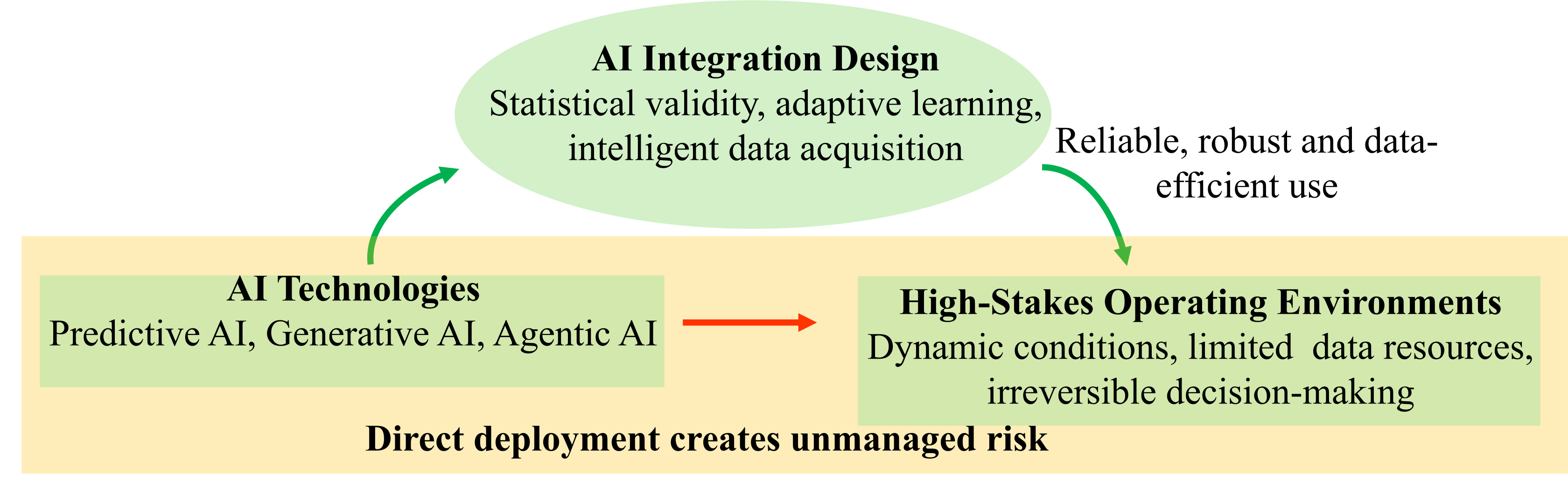
My research develops AI integration designs that enable models to operate reliably, robustly, and data-efficiently in high-stakes scientific and healthcare settings. I focus on assurance methods and risk-aware strategies for integrating AI capabilities into real-world decision systems: validating and monitoring AI-assisted decisions, adapting models to changing operating conditions, and acquiring informative data under limited operational resources. This agenda is organized around three pillars. Statistical validity provides explicit error-rate control for AI-assisted decisions. Adaptive learning characterizes and exploits heterogeneity in operating conditions to support robust prediction across diverse and dynamic environments. Intelligent data acquisition guides the allocation of limited data-collection resources, including experimental measurements and data annotations. Together, these pillars enable the reliable, robust, and data-efficient integration of AI into high-stakes decision systems.
Selected Publications
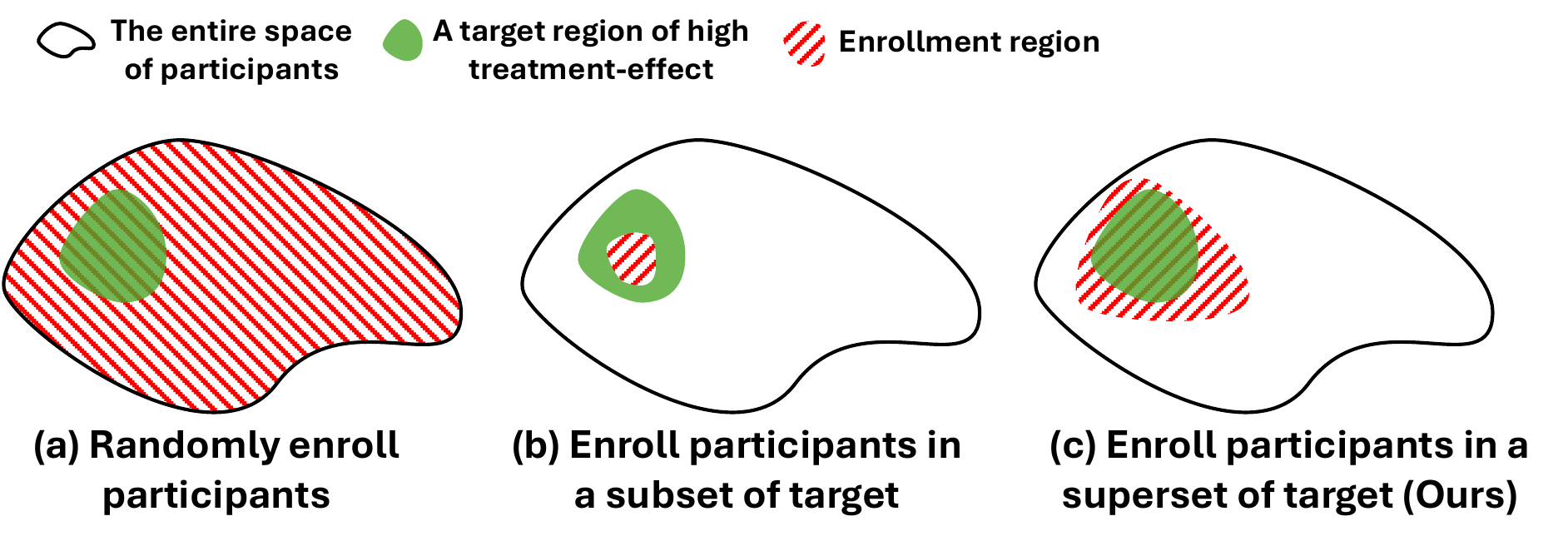
Weizhi Li, Gautam Dasarathy, and Visar Berisha. "Matched-Pair Experimental Design with Active Learning." Conference on Uncertainty in Artificial Intelligence (UAI), 2026.
Integrates machine learning with matched-pair experiments to detect causal treatment effects under limited resources. The proposed design uses agnostic active learning to prioritize treatment-responsive regions while identifying an enclosing region that provides an upper bound on the size of the responder region under the stated assumptions. This supports decisions in multiphase clinical trials: whether a treatment may benefit a sufficiently broad population to justify a larger, more expensive experiment.
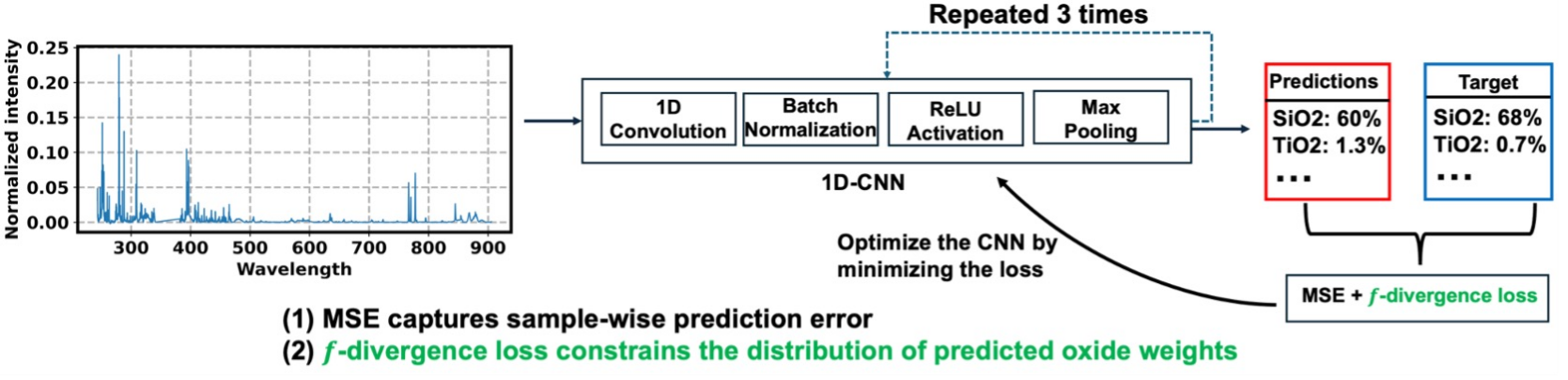
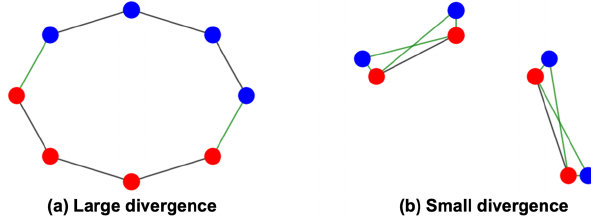
Weizhi Li, Natalie Klein, Brendan Gifford, Elizabeth Sklute, Carey Legett, and Samuel Clegg. "Regularization via f-Divergence: An Application to Multi-Oxide Spectroscopic Analysis." JGR: Machine Learning and Computation, 2026.
Develops a neural-network training approach for stable spectroscopic characterization of oxide weights under extreme simulated Martian conditions. The approach embeds comparisons between multi-oxide predictions and certified reference weights in an f-divergence loss, guiding the network to learn the underlying multi-oxide distributions. The left diagram shows how f-divergence regularization complements the prediction-error loss during training; the right illustrates large versus small divergence between predicted and reference oxide-weight distributions.
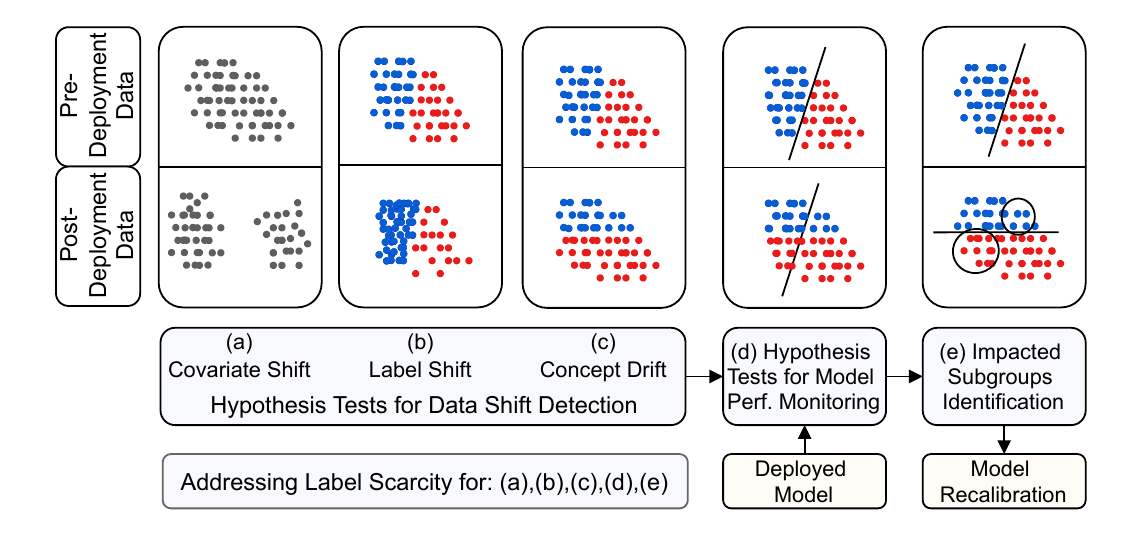
Pavel Dolin, Weizhi Li, Gautam Dasarathy, and Visar Berisha. "Statistically Valid Post-Deployment Monitoring Should Be Standard for AI-Based Digital Health." Conference on Neural Information Processing Systems (NeurIPS), 2025.
Healthcare operating conditions are dynamic: patient demographics, clinical practices, equipment, disease patterns, and data-acquisition procedures can shift. Yet a review cited in this paper found that only 9% of FDA-registered AI-based healthcare tools included a post-deployment surveillance plan. The paper argues for statistically valid, label-efficient post-deployment monitoring to detect shifts in data and model performance while controlling explicit error rates.
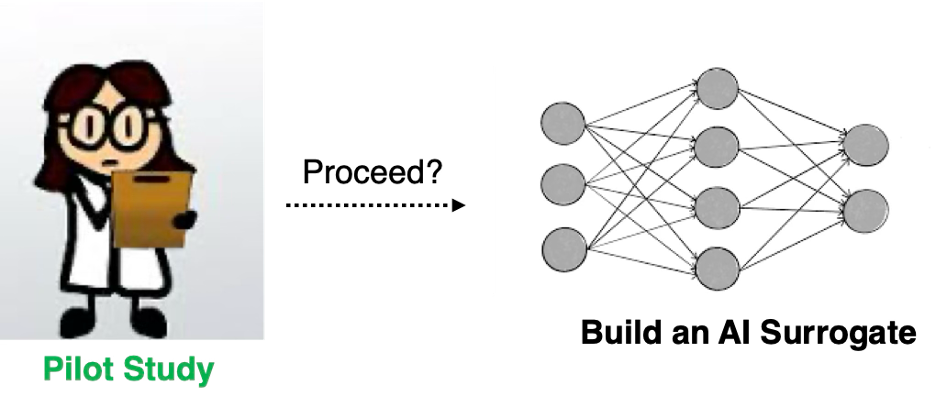
Weizhi Li, Visar Berisha, and Gautam Dasarathy. "Advanced Tutorial: Label-Efficient Two-Sample Tests." Winter Simulation Conference (WSC), 2024.
A tutorial on resource-efficient methods for revealing dependence on an exposure variable in industrial-scale simulation applications. Using the familiar machine-learning variables of features and labels, it presents statistical tools to detect whether labels depend on features before committing to large-scale computation, such as developing AI surrogate models for scientific simulations. These tools enable a pilot study to gauge whether data contain predictive signals and are ready for machine-learning modeling.
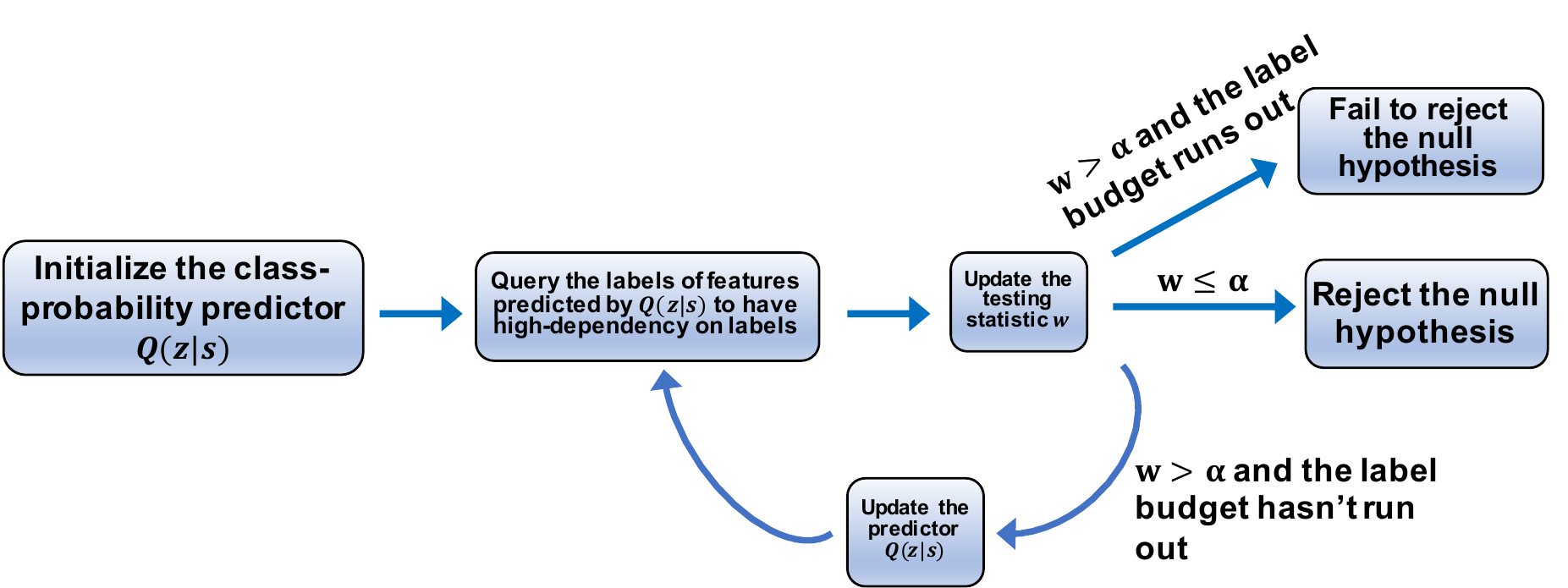
Weizhi Li, Prad Kadambi, Pouria Saidi, Karthikeyan Natesan Ramamurthy, Gautam Dasarathy, and Visar Berisha. "Active Sequential Two-Sample Testing." Transactions on Machine Learning Research (TMLR), 2024.
Proposes a framework for detecting observational dependence between measured features and an exposure or group variable when labels are costly. The design combines machine learning with active, sequential two-sample testing to decide where to collect data and monitor the accumulated evidence. Anytime-valid inference guides the next step: continue collecting data, stop without rejecting when the budget is exhausted, or reject independence to establish evidence of observational dependence.
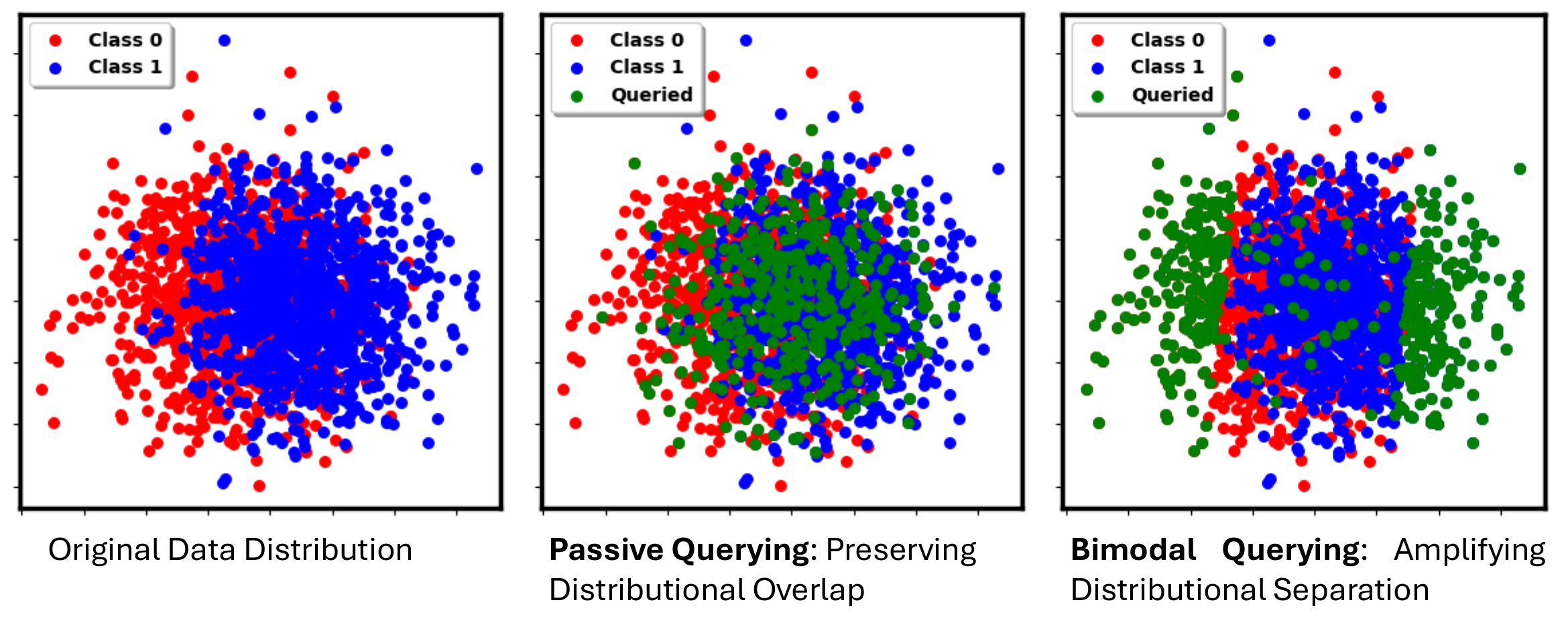
Weizhi Li, Gautam Dasarathy, Karthikeyan Natesan Ramamurthy, and Visar Berisha. "A Label-Efficient Two-Sample Test." Conference on Uncertainty in Artificial Intelligence (UAI), 2022.
Introduces bimodal querying, which reverses the uncertainty-seeking principle of conventional active learning: in binary classification, it requests annotations where the model is most confident in class 0 or class 1. Combined with a two-sample test, this exposes predictive signals with fewer labels. Subsequent analysis establishes asymptotic maximization of feature-label mutual information under consistency conditions. The approach supports rapid signal assessment, including evaluating whether data contain useful predictive information for an AI task.
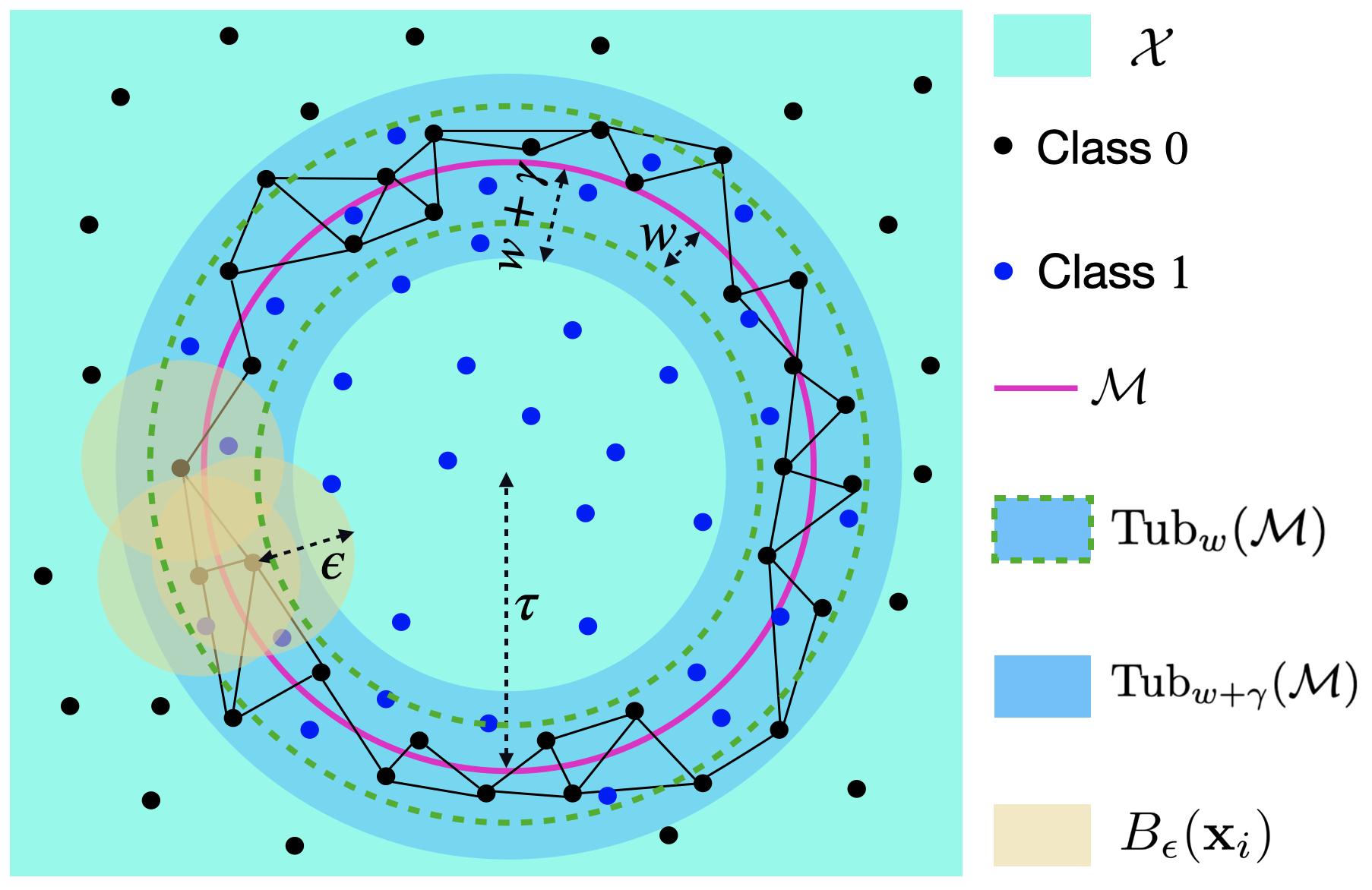
Weizhi Li, Gautam Dasarathy, Karthikeyan Natesan Ramamurthy, and Visar Berisha. "Finding the Homology of Decision Boundaries with Active Learning." Conference on Neural Information Processing Systems (NeurIPS), 2020.
Proposes an active-learning framework to efficiently estimate the topological properties of a decision-boundary manifold. These properties support evaluating AI tools from a model marketplace using a topology-based comparison metric. The work establishes conditions under which boundary homology is recoverable, grounding the metric's reliability and the selection of models for downstream tasks. The left diagram illustrates the boundary geometry and sampling conditions; the right shows the active homology-estimation pipeline.

Weizhi Li, Gautam Dasarathy, and Visar Berisha. "Regularization via Structural Label Smoothing." International Conference on Artificial Intelligence and Statistics (AISTATS), 2020.
Characterizes intrinsic structural complexity through local class overlap and develops structural label smoothing to adapt neural-network training to that complexity. By choosing smoothing strengths from the data's structure rather than imposing uniform regularization, the method adapts a general-purpose learning algorithm to a downstream task using its intrinsic structural properties. The figure traces the process from the original data through local complexity estimates to adaptive smoothing strengths.

(a) Original training data (b) Cluster training data (c) Estimate local Bayes error (d) Infer smoothing strengths
Honors and Awards
- NeurIPS Top Reviewer Award
- UAI Student Scholarship
- Graduate Travel Award, Arizona State University
- , Engineering Graduate Fellowship, Arizona State University
- Poster Award, SWE Region C Conference Poster Competition
- Graduate Merit Scholarship, Texas A&M University
Selected Talks
-
Label-Efficient Two-Sample Tests
Invited talk · Statistics Seminar, University of New Mexico
-
Label-Efficient Two-Sample Tests
Tutorial talk · Winter Simulation Conference
-
AI-Enhanced Exploration for Planetary Science
Invited talk · Applied Machine Learning Summer School, Los Alamos National Laboratory
-
Designing Two-Sample Tests with Local Information
Invited talk · LIONS Seminar Series, Arizona State University
Professional Activities
- Journal Reviewer: IEEE Transactions on Information Theory, IEEE Transactions on Artificial Intelligence, Journal of Combinatorial Optimization, and Transactions on Machine Learning Research.
- Conference Program Committee: NeurIPS, ICML, ICLR, UAI, AISTATS, IJCAI, and AAAI.